A single rule cannot cover this catalogue
Nearly every fit question here takes the same shape: what size should I order? It depends on the style, because That’s A Awful Lot Of Cough Syrup puts out its fit guidance product by product, not once for the range. A pair of tee styles run small enough that the brand asks you to go one or two sizes bigger. True to size is what the majority of pieces are published with. A further two fit true to size but invite you to size up for the oversized look. Guidance of that kind cannot be folded into one rule, and applying one anyway is how returns happen.
The missing size chart, and what that means for you
The brand publishes no global size chart. A general sizing awfullottacoughsyrup.com chart and a separate t-shirt size chart, its own sizing pages, render without any chart content as of September 2026. It is not a temporary outage; it is the state of the site. Read the product description in full, because it is your only authoritative source on fit. Whatever measurement table for alocs clothing turns up on a resale listing, a blog or a lookalike store is somebody else’s reconstruction, not a published figure. Those charts are guesses, so read them that way.
The size range you are picking from
First, what is actually on offer. Small through extra-large is listed on nearly every style, and apparel runs XS to 3XL. A 3XL buyer shops a subset of the catalogue, because 3XL appears on 48 products and the top is narrower than it looks. Kids sizes run 2/3, 4/5, 6 and 8. Denim and workwear sit off that ladder, but sized by waist from 28 through 44. The sections below are organised by situation, and every instruction quoted comes from the brand’s own copy.
Where the style runs true to size
Over most of the catalogue this is the default, and the easiest case. Published as fitting true to size: the Classic Cough Syrup T-Shirt, Hoodie and Sweatpants, the Dickies Button Down, the Dodger T-shirt, the Double Cup Cargo Shorts, the Women’s Booty Shorts, and the King Of The Kill, Drankenstein and Juicebusters tees. With all of these, order the size you normally wear. The classic tees are published as relaxed-fit, so true to size already means a roomier body than a fitted tee. In a classic awful lot of cough syrup shirt, the medium you usually wear buys you a relaxed medium, not a slim one. More room puts you in the next situation.
Where the page says to size up for an oversized fit
Two styles carry a note that does two things at once, and it is easy to misread. The Warning T-Shirt is published as true to size, with the added line that for an oversized fit you should consider sizing up. On the Double Cup Cargo Shorts the wording shifts slightly: they run true to size, and for an oversized fit you size up one. What the brand is doing is explaining how to reach a looser silhouette; the garment is not mis-sized. Take the instruction as conditional, not as a correction. The intended fit comes from your normal size; if you want it big, go one up and stop, because the note says one.
Where the style runs small
The cost of skipping the product copy is highest here. The Wok Is Dead T-Shirt and the Promethazine Tour T-Shirt carry an explicit warning on the page: the style runs small, so order one or two sizes bigger than your regular size for a relaxed fit. Unlike the heavyweight classic tee, both are wide-fit, cropped tees in lightweight cotton jersey, rinsed for a vintage feel, with water-based prints front and back. A cropped body is meant to be short, so the extra size buys length as much as width. A large or extra-large is where that lands you here if you normally wear a medium. This is the plainest illustration of why one rule cannot cover thats an awful lot of cough syrup as a catalogue.
When the brand publishes flat measurements
A few products publish actual flat measurements, and these beat every rule of thumb. For the Wok Is Dead and Promethazine Tour tees the brand publishes width by length from the back: small 20 inches by 17.5, medium 21.5 by 19, large 23 by 20.5. On the Double Cup Cargo Shorts, waist and inseam: small 29.5 inches and 7.75, medium 31.5 and 8, large 33.5 and 8.5, extra-large 35.5 and 9, 2XL 37.5 and 9.5. The method is plain: lay flat a garment you own and like, measure armpit to armpit and collar seam to hem, then compare. Use the measurements wherever they are published, and disregard everything else. More than any letter can tell you comes out of that comparison, and it assumes nothing.
When you are shopping for bottoms
Buyers get caught out by the second logic that bottoms follow. Sweatpants and sweat shorts sit on the XS to 3XL ladder, and the Classic Cough Syrup Sweatpants are published as fitting true to size. Because denim and workwear go by waist from 28 through 44, there is no letter to convert. The cargo shorts, the carpenter pants and the Dickies-based trousers are all covered by that. Nothing published converts between them, and the two systems do not map onto each other. When you are shopping alocs shorts and the listing gives a waist number, measure trousers you already wear rather than guessing.
When the product page tells you nothing at all
Judgement comes in where a listing carries no fit note at all, which is plenty of them. Wherever the brand does publish a note, the default is true to size, which makes it the safest assumption. A 16 oz hoodie and a 6.5 oz tee behave very differently, so let the garment type guide you beyond that, and remember that heavier cloth is less forgiving. For an awful lot of cough syrup hoodie with no note, your usual size is the reasonable default, and one up if you want it oversized. Because a lightweight cropped tee running small says nothing about a fleece sweatpant, no rule should be imported from one style onto another. Choose one that does publish a note when the piece matters and the page stays silent.
What to order, taken style by style
Every published fit instruction is gathered in the table below. What the brand says on the product page occupies the middle column, and the right column turns it into a decision. Nothing here has been inferred from resale listings or reviews, or averaged into a general rule. Nothing has been published for a style that is absent, so the true-to-size default applies. Read it alongside the product page, not instead of it, since products come and go every few weeks. All of it was checked in September 2026.
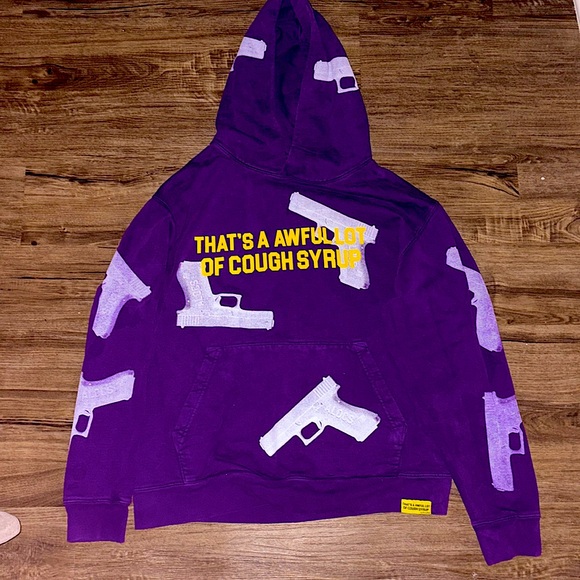
| Style | What the brand says about fit | What to order |
|---|---|---|
| Classic Cough Syrup T-Shirt | Fits true to size; relaxed fit | Your usual size |
| Classic Cough Syrup Hoodie | Runs true to size | Your usual size |
| Classic Cough Syrup Sweatpants | Fits true to size | Your usual size |
| King Of The Kill, Drankenstein, Juicebusters tees | Style fits true to size | Your usual size |
| Dickies Button Down, Dodger T-shirt, Women’s Booty Shorts | True to size | Your usual size |
| Warning T-Shirt | Runs true to size; for oversized fit, consider sizing up | Usual size, or one up for oversized |
| Double Cup Cargo Shorts | Runs true to size; for oversized fit, size up one | Usual waist, or one up for oversized |
| Wok Is Dead T-Shirt | Runs small; order 1-2 sizes bigger than your regular size | One or two sizes up |
| Promethazine Tour T-Shirt | Runs small; order 1-2 sizes bigger than your regular size | One or two sizes up |
| Any style with no published note | Nothing published | Usual size; one up for oversized |
A last word on charts you find elsewhere
It bears repeating, because it is the point most likely to save you a parcel: there is no published size chart for this brand. The pages that ought to hold one load without any chart, and no gap is filled by the frequently asked questions. Whoever built the charts circulating under the brand’s name did it by measuring one garment or copying a template, and neither accounts for a catalogue where one tee runs small and another runs relaxed. With a refund window of a month from purchase and return shipping paid by the customer, returns exist, so a wrong call is recoverable but not free. Only three things are reliable: the per-product fit note, the published flat measurements where they exist, and a tape measure against something you own. Reading the copy properly is cheaper than posting a box back.

